Heyy y’all. I have a little something new new for you J I had a chance to connect with the good folks at Fizzy Goblet all the way in the motherland. Pretty awesome, right? I love Indian fashion, the prints, embroidery, the rich history and traditions that continue to inspire designs. One thing that makes Indian fashion unique is companies like Fizzy Goblet, one of India’s favorite handcrafted jutti designers. They are all about mixing the new with the old for a fun, contemporary look. Launched just six years ago, Fizzy Goblet is making waves in the Indian footwear market and has been featured in magazines like Elle India.
Mirror Mirror Blush Jutti
Bloom Broguesters
Parrots from the Wedding Collection
Tell us about Fizzy Goblet? We use bright colors and we make bold statements. We’re about subtle textures, intricate patterns and patent prints. Fizzy G is for the curious and experimental, for the light hearted and the passionate, we are for everyday adventures, taken one step at a time.
Fizzy Goblet is a such a fun, unique name, how did you come up with it? A love for Harry potter, wine and all things fun.
What has been your biggest “wow” since you launched Fizzy Goblet? I think every time a customer comes back to get another pair or tell us how much they love their Fizzy Gs, is a wow moment.
What surprises you most about your brand and what you have been able to accomplish? The fact people are so open and in fact hungry to try new concepts and designs that we set out to create.
The design team is very creative. I love the various styles, mix of prints and materials. How did the brogue juttis come about? It goes with the whole brand concept of merging the old with the new and the traditional with the contemporary. They are essentially juttis which have been worn in India for years, but we wanted to add another modern turn by using the brogue design but still use Indian fabrics like Ikat to create a completely new style.
Brogue Juttis
Is this your most popular style? Yes, it is one of our more popular designs.
What would you say inspires the design team? Anything and everything! Inspiration lies in something as simple as a whimsical looking tea set or a colour combination spotted on a window on the streets of Bombay. It could literally be anything.
What new prints and styles should we look out for this yer? Playful is a key direction for us in 2016 with an emphasis on boho chic with interesting, unexpected elements.
For the young designers and brand entrepreneurs what is the best piece of advice that you would like to share with them? Stay true to what you believe in in terms of your design aesthetic. Don’t blindly follow trends.
Wisdom from a true fashion guru. Thanks Fizzy G! If you’d like to order a pair, they do have international shipping. Cheers to mixing fits for Indian inspired looks!
She’s young and about her business! Meet Saundarya, aka Houston’s Henna Plug. From traditional Indian weddings to casual henna for men and women, black henna, colored henna, white henna… she does it all. Saundarya is the best around town, super talented with an eye for detail, as you’ll see with her beautifully intricate henna designs. She even used to make her own henna. How cool is that?! “Henna,” sometimes referred to as mehndi, “is a plant,” Saundarya explained to me as she was doing my henna. “It comes from the dried up leaf of the plant. I haven’t made henna in a long time so I don’t remember all the ingredients.” Now, she uses a premium, all organic henna. Check out how she got started, what inspires her and more in our chat below.
Having fun while Saundarya creates
Juttis
The plug!
Finished product *love eyes*
That’s awesome you used to make henna. How did you get into henna as not only an art, but also business? As a kid I always doodled in my notebook and made designs. One day my mom came home with a henna cone, “Here, you should try this.” So I tried it… and it came out really bad so I was like, “I’m just going to throw this away. I’m not gonna use it anymore.” Then one day, a few years later, I picked it back up and thought I should give it another shot. That was in high school. I kept practicing this time and that’s when I started getting better. I started practicing on myself, my friends, family. I realized I was really good and henna was starting to get extremely popular. Since I do this, I thought, “I can easily get my foot in the door.” I started January 2015, I still have a lot of progressing to do.
How did you start getting clients? I just started showcasing my work. When I started, I had no website, no promotions, just Instagram and word of mouth. That’s still all I have. People would see my work, the quality and reach out.
Do you have a lot of American clients or mostly Indian? Mostly other cultures. With Indians, we get it for Holidays, weddings, special occasions. If you go to an Indian person’s house with henna, they’ll say, “Did you go to a wedding recently?” No, I just always have my henna done (lol). With them, it’s like why would you get henna for no reason? Americans do it for fun, like something cute to get done on my birthday or some see it as a temporary tattoo. It’s not a cultural thing or embracing the culture, and it’s not spiritual to Americans like it can be [symbolic] for Indians, for example, henna night on weddings.
What is the cultural meaning behind henna? I don’t know exactly where it started. I think it originated in Hindu culture, and then grew to Middle Eastern culture. After India and Pakistan separated, the Muslims went to Pakistan then Saudi Arabia and that’s when it started spreading. It started off as part of the [Hindu] wedding celebration. It’s more of a traditional thing, cultural not religious. There’s symbolic meaning, but not spiritual like opening a third eye.
Someone once told me henna represents love. I do get that, but I think it’s an old Indian superstition, like if your henna comes out really dark, it means your mother-in-law is going to love you a lot.
Can you talk about the different kinds of henna? Nothing is actual henna except red. Red is the only traditional, organic color. Black is ink. Black henna lasts five or six days tops so I tend not to promote it. I always warn people ahead of time. Red henna lasts 2 weeks. White henna is actually body paint without the gel. Without the gel, it’s not going to wash off; well it’s not supposed to wash off. White henna is something you do for people that want it for that day. Now, they’ve started making different color hennas, its just paint without gel. You can have any color if you’re willing to only have it for a day or two. That’s why I feel red is always the best option, it won’t react to the skin, cause irritation, discomfort.
Do you apply all of them the same way? What’s your favorite to work with? My preference is definitely red, they don’t go on the same. I actually have black with me, let me show you. *She shows me how the black henna is applied.* See, I have to press against your skin. It’s blobby, it’s literally like ink. The red comes out in a straight line naturally. Oh, and with black, there are no mess-ups. I have to be really attentive with black; it’s not like red henna.
How do you come up with your designs?
Usually people come with a preset design. I usually take the design as inspiration and work with it. I’m not a fan of using someone else’s work. Show me something you like, I’ll look at it, work with it and twist it to my style, what I think will be cute. Everything I show people, everything on my Instagram, I want them to know this is where my mind is. Unless someone requests something specific, like I really want this exact design, then I’ll do it. I wont argue with my client.
You started talking about how you freestyle designs. Can you talk more about how you freestyle, the craft of henna? It took a while. I had to build my experience. The more designs in my mind, the better I am. When I first started freestyling, it was bad. Well not bad, it just wasn’t where I am now. Now, I’ve developed a flow. I can do a full sleeve. Most established henna artists have set designs, no options. I’d like to stand apart from this trend. It shouldn’t be up to the henna artist what you’re going to have on your arm. If you want me to freestyle, I should have a flow. To be able to freestyle successfully, your expertise has to be at a certain level.
What makes your style unique and different than what others are doing? I have a very neat hand and you are going to be happy. That’s one reason I always tell people [why I’m the plug!]. People will come to me and tell me I have changed their whole henna experience. They went to a salon and that’s the worst place to go. You would assume that’s your best option, but it’s not because it’s not their forte. When people come to me, they know they’ll get what they want. It’s a different quality and expertise that I offer. I wont leave something on a client’s hands that I don’t approve of. With some others, they’ll think oh, they’re American, they won’t notice. But people notice. I always want a good impression so I put my all into it. I appreciate the word of mouth and always want a positive outcome. I know my potential and what I can produce.
I don’t like leaving people unhappy so if I don’t like something, if it’s not aligned properly, I’ll erase your whole hand and start over. If you’re paying for it, you should be happy. I want you to be satisfied. If someone goes home and isn’t happy, the stain isn’t dark enough or something, I’ll say lets meet up tomorrow. There’s no excuse for me to not make sure that happens. I don’t want any dissatisfaction at all. It’s not about the money or the sales. My mom told me if I’m doing this as a business, it’s about the people.
That’s a great word from your mom. Do you have any tips or tricks to make henna last longer? A stain is usually at its darkest 24-48 hours after you apply it. I usually tell clients if you want your henna to be its darkest, leave it on the entire day and through the night. It’ll start to flake off, but really take it off the next day. The longer you let it stay, the longer the oil sets in your skin. It’ll flake in your bed though if you do sleep with it.
What should we be looking out for from you? It has to be my year. I won’t accept anything less. This will be my year of establishing clients that come to me on a regular basis. I don’t want you to consider another artist because I want you to know I’m the best. This summer will be fun; hopefully I’ll be doing group henna parties. It’s a great season to get henna, for pool parties, the beach, vacation.
What motivates you? I finally found my niche. I’m 23. I’ve spent the past few years not completing my bachelors, kind of bouncing around trying to find myself. I’ve finally found something where I am content. I can take this and run with it, make this a business. Everything else I’ve done, it’s been, “I don’t know if I like this.” With henna, it’s never been a question. I can do this day in, day out and I will never get bored of it, never get tired of it.
What does creating with purpose mean to you? When I see people happy, it makes me happy. I know what it is to be down. Every person whose henna I do, regardless of how small or big it is, I have the opportunity to shine a little bit of happiness.
How legit is Saundarya y’all!? Since I spoke with her, she’s already hit one of her goals for the year, partnering with a salon. You can find her on Saturdays in the Galleria at Momentum Hair Designs. Any other time during the week, hit her up and she’ll meet you for your henna needs. Henna party for the summer anyone? Don’t forget to follow her on Instagram, @houston.henna.
She’s super sweet, makes delicious gelato and is a boss lady entrepreneur! How could you not love Jasmine? I met Jasmine at Whole Foods while she was doing a tasting of her products. Her mouth watering unique flavors stood out to me, malai kulfi, bourbon caramel, curry coconut milk… they might sound a little odd for gelato but they are absolutely delicious! I had a chance to sit down with Jasmine and chat about how she started Sweet Cup Gelato.
This slideshow requires JavaScript.
How did Sweet Cup Gelato start? Sweet Cup started on a honeymoon trip to Italy. I really fell in love with gelato. I had no clue what gelato was. I’ve always been an ice cream girl. I grew up on Blue Bell. My dad got me into ice cream so when I had this product, I thought it was a frozen custard or some kind of pudding. I instantly fell in love. I love the fact that the Italians put so much passion in, not just gelato, but the desserts, their food, their life. I was really inspired by that one trip.
When I came back, I decided to make gelato as a hobby at home on the weekends. It became something that grew into a bigger passion, I wasn’t trying to start a business or looking for something to do differently, it was just for fun. I started taking it to friends’ houses for dinner parties and people would joke, “you should start your own gelato shop”. The wheels started churning and I had an AHA moment. That would be pretty fun, I love doing and eating and making gelato. I decided to quit my job and really fully go into this. It wasn’t an overnight decision, a yearlong process.
I took classes on dairy science and took my advanced training in Italy. I was really serious about this so either I did something about it or I didn’t. I saw an abandoned Marble Slab and that was my sign; I had to start Sweet Cup. I love the Montrose area. My husband and I put our savings, everything we had, and we started Sweet Cup.
When you went abroad to study in Italy, did your husband go with you? Umm, no.
How did that work out? As entrepreneurs, business owners, we have to make sacrifices, sometimes give something up. That’s a huge step he supported you in. When I went to Italy, it wasn’t strictly for starting a business; it was more for me to understand gelato, for fun, more for me. I took time off, time away to do it. And I thought if something comes out of it great, if not, I have something I will always treasure and be happy with.
After I came back, we sat down and made a list of pros and cons and all the possibilities that could go wrong with doing this. The cons of a lot of things were related to us being a local startup and neither of us had restaurant or food experience, only me making gelato and desserts at the house and having a passion for it. He’s an engineer, so he doesn’t know much about this industry. It’s such a specialty industry that the banks pegged us at 90% failure rate the first year. They are very wary of investing in startups that are so specialized in the food industry and on top of that, we had no prior experience. I only had my certifications and classes and gelato examples as proof, but nothing to back me. That was the biggest risk of both of our lives.
The banks rejected us many times and the SBA didn’t even support us. Actually, one guy at the SBA, really old man looked like he was from the 1900s, told me, “young lady, I feel like this is an industry more male dominated, more Italian.” He didn’t say because I was a woman straight up. This kind of set me back, to see that they didn’t even support me or give me valuable advice to walk away with so I was kind of on my own.
Then I thought that added more fuel to the fire. Instead of taking all those rejections and going home and crying, I said you know what, I’m going to do something about it, screw it, I’m gonna go open that gelato shop and give it my all. At the end of the year if no one comes in, no one likes it, I know I tried my best.
After all those rejections, people saying we couldn’t do it, I decided to do it, not for them, but for myself. And I thought I’m gonna do it, what do I have to lose anyway?
How did you come up with the name, “Sweet Cup”? Sweet Cup came from my dad. Any general statement he would say, “go get me a sweet cup” of ice cream, it wasn’t gelato.
What were you doing before? I worked at the San Antonio Express News. I’m from Sab Antonio, TX born and raised. I’ve never been in the restaurant business so this was something that was scary but interesting and intriguing.
How was the transition? It was tough. I’m going to be honest, very tough.
What made it tough? It wasn’t making the gelato because I love doing that. That’s fun to me to create a flavor. The toughest part was everything about running a shop, a retail location. Not about brooming, mopping and sweeping. When you run a shop, you set your ego at the door. People come here because they want to experience a sweet cup of joy. To get away from outside world and have that moment. The toughest part is running a business of your passion. Transitioning to a business aspect is a whole new level you have to worry about. As you grow, you need support. Good help is hard to find. It’s all about the growing pains in a business
The first year, we couldn’t afford to hire anybody. It was me manning the front, my husband helping me out in the back on the evenings and weekends and me running in between production manning the store. That was really really tough. More than 100 hours a week, 3-4 hours of sleep. Settling the business was really difficult. We didn’t advertise or network, we didn’t put ourselves out there. That might be my biggest regret. And I think I did it because I wasn’t sure if people would like it, if people would like malai kulfi in gelato form.
What is the most rewarding part of having Sweet Cup Gelato now? When you create with your own hands and hard work, giving that cup of gelato or sorbet, and seeing a reaction from your customer… that’s the best part. Creating something and people enjoying it. Like, I can just roll over and die right now. People will tell me, “Oh this takes me back to my childhood.” I feel proud.
How do you come up with the flavors? A lot of these flavors are nostalgic for me. Like butter pecan, that’s something I grew up on with my dad. Malai kulfi is a favorite, but I personally don’t like the texture, it’s a little too icy for me. I’ll do something to represent my heritage, mom is Persian. Tres leches cake because I grew up in San Antonio… stuff that reminds me of home and how I grew up, being a Texan. My background, husband’s background, all the cultural influences and different cultures in Texas play a big part in how I come up with flavors too. Olive black pepper reminds me of Italy. Curry Coconut milk reminds me of my husband (he’s Indian) and represents Houston’s diversity and culture. I just love to play around with things. I like to do things with a different twist, out of the box. That’s always been me, I’ve never been a vanilla girl.
Do you have a fav? Honestly, it’s hard to say, I don’t have a favorite. I would love to have one, but each one is very personal to me. I do a lot of experimentation; I’m always trying my best to evolve.
What motivates you? Gelato. Maybe this sounds corny, but I feel like I have a purpose, a mission to make a good product and for people to enjoy it. When families come and they’re so happy to introduce others to this place, when I see people get so excited about the product and appreciate what I’m doing that they get to know me as a person. That gives me drive. A purpose that I’ve never had with any job in my life.
Wow, such a sweet (pun intended :)) story! If you live in Houston or maybe just visiting the city, make sure you stop in for a delicious sweet cup and tell Jasmine hi! ❤
Hey y’all, I’m so happy to share this piece onblujeen! It’s been one of my go to spots and Harlem favorites since it opened earlier this year. I had the chance to speak with the owner, Chef Lance Knowling, about the restaurant concept and how it came to be! Check it out below ☺
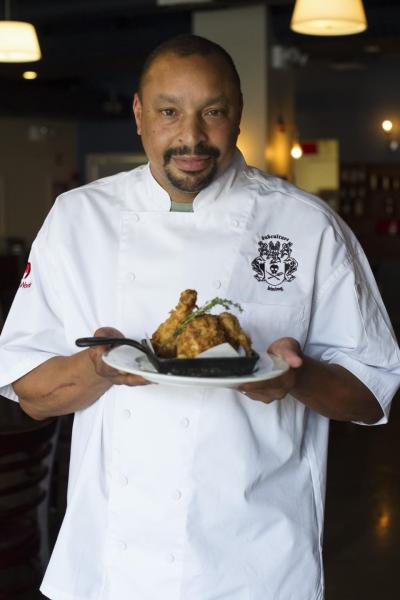
Meet Chef Lance. He has owned four restaurants,blujeenis his fifth. He is originally from Kansas City, went to culinary school, worked in many differently places as an apprentice, moved to Dallas (the great state of Texas!) in 1983, then moved to NY in 1988 and has been here since.
“I can open a restaurant anywhere in NY, but for me, I wanted it to be here. This, to me, is storybook.”
Tell us about blujeen! How did it start? Why Harlem? Where did the name come from? (I know, I know… I started off by asking five questions in one. I got called out too lol)
Chef Lance: It’s usually one question at a time. Haha. Well,blujeenis first and foremost a concept. It’s my interpretation of comfort food. With my background, training and experience and the kind of food that I like, but combining that with traditional techniques as well as classical techniques. I’m classically French trained. I wanted to introduce a different type of comfort food. A lot of the inspiration comes from my upbringing, my mother, in-laws and family, gatherings. I wanted to recreate that inblujeen. That’s really where the inspiration came from, I thought it would be a good vehicle for my type of cuisine, my type of food.
Why Harlem?
Chef Lance: I love Harlem. I’ve worked in Manhattan for years. It was one of those childhood dreams to own a restaurant in Harlem. I mean, I can open a restaurant anywhere in NY, but for me, I wanted it to be here. This, to me, is storybook.
Prior to blujeen, what were you doing?
Chef Lance: I’ve owned a series of restaurants named Indigo Smoke. All of my restaurants are blue something. I opened the first one in 2002, Indigo Kitchen & Bar, and I’ve always catered. That’s pretty much what I was doing until I opened up here. Our focus atblujeenis just the restaurant and catering. I don’t have the other restaurants anymore, I sold them. This is my focus.
[Fun fact! He catered Chelsea Clinton’s wedding.]
That’s is a huge accomplishment!
Chef Lance: Yeah, I guess so. I try not to get too caught up in that. It’s such hard work that it’s really just keep working. Don’t think about anything else, just keep working.
What keeps you motivated?
Chef Lance: If I’m going to be completely honest with that, my motivation is always food related. I’ll make something and I’ll love it and people will love it, then I want to do something else. I’m always pushing towards the next thing. I don’t know if that’s my character or what, but I’ve always been like that. I’ve been in the business since I was 17. It’s really the only thing I’ve ever done. It’s part of my makeup. That’s my motivation, to do something else, to do more.
You kind of touched on it, looking at this as a big accomplishment but not focusing on that and keeping it moving. For my peers especially, we look at where we are and it’s great, like we made it here but we keep pushing for what’s next. There’s a kind of a battle between complacency and contentment. How do you find the balance of pushing forward with new goals, but still being content?
Chef Lance: First and foremost, I’m never satisfied. I don’t know if that’s good or bad. But I think that helps to keep from becoming complacent. Sometimes you sit back and you go, “that is pretty cool” or you read something nice about yourself or you hear a compliment that kind of keeps you going. But, because I’m never satisfied, I keep doing it. I don’t think I’ll ever become complacent. The most I would ever be, I would just quit completely. I’d find a beach somewhere, some lemonade or iced tea. I don’t know if that day will ever come. I work seven days a week and I don’t see myself doing anything else.
“Success is the end and I’m no where near the end.”
What have been some of the challenges in getting to where you are in your career and overcoming them?
Chef Lance: I think a lot of those challenges are still there. They never really go away, you just manage them differently. As you get older, hopefully you get a little smarter, a little more patient, which is not always a good thing, but you do become that way. A lot of the challenges and hurdles that I’ve faced in the business still remain today which is why we have the Black Chef Series. Personally speaking, I don’t think there has been a time in my life where I’ve said to myself, “I’m successful.” That’s never happened.
We all define success differently.
Chef Lance: I guess by some other person’s standard, I would probably be successful. I think I have so much more to do, I just cant look at myself and say you’ve done enough or this is the best you can do or you can’t do more. I’ve never had a day like that. That doesn’t mean there aren’t times when people like your restaurant or great things happen in your life where you say I’m really proud of myself. Success is the end and I’m no where near the end.
Interesting way to put it. I don’t think I’ve heard it that way before. You were talking about the Black ChefSeries,it’s an awesome concept.What inspired it and how did it come about?
Chef Lance: I have lots of concepts and ideas for things. I talked to a few of my chef friends about it before I opened up. I was sitting with Chef Max and Alize, Max Hardy is a big part of theFoodBank of NY and other charitableorganizations like that. We were talking about how we can combine charitable concepts with chef concepts. I introduced them to the Black Chef Series and they ran with it. They’ve done a lot with it. We have a nice nucleus forming to go forward with. Everyone is talking about the next one. Is there a winter series or a holiday series? We might take it on the road, we’vereceived phone calls… a lot of great ideas around the Black Chef Series. We have to see what direction we want to go.
“I always wanted my restaurant to be that kind of place, where other chefs can come in.”
When I was coming up as a chef, there wasn’t anything like that, certainly not for black chefs. It’s always been difficult for black chefs to get noticed. I’m not just talking about black people who can cook, but chefs, people that have gone to school, have formal training, have worked at some of the best places in the country, have put in the time and they don’t get any recognition.When it’s time for them to make that next step, a lot of restaurants are unwilling to give them the head chef, executive chef title because they don’t want their patrons to see a black face manning the stove. It’s as simple as that. You don’t have to sugarcoatit. More and more black chefs are getting opportunities, but its very slight. I talk to the younger generation and they’re finding the same roadblocks. It’s difficult.
Switching gears a little, let’s talk the food you make. What’s your favorite dish to make? In general, it could be at home with family, for holidays or at this restaurant?
Chef Lance: Well you see that’s two different things. There’s professional cooking, there’s business and friends and family… that’s a completely different attitude.
Can you talk about the difference a little?
Chef Lance: A restaurant is a stage, it’s a performance to a certain degree. You’re doing things to appeal to multiple people. You want to make food that is personal. You’re creating, that’s why you have a menu. You have people who are gluten free, who are vegetarian, people who don’t eat pork.A professional has to create dishes for all of those people and they all have to taste good. That’s where the profession comes in, multiple people can come in and enjoy your work. At home, you don’t really care about that. When you cook at home, its what you want to eat. At home I might make that shrimp and grits, three, four, five different ways because I’m going to eat it regardless. Ultimately, we always revert back to what mom and dad fed us growing up. That’s a part of flavor memory. That never goes away no matter what. What you’re fed as a child never goes away.
I don’t know what your heritage is but…
I’m half Indian, half black, my dad is from India and my mom is from St. Louis.
Chef Lance: I’m from Kansas City. That’s BBQ country. The earliest food memories I have are all around BBQ, grilling, fire. I still like that and there’s a lot of those elements in my cooking: charring, fire roasting, grilling, because I like that edge. Youcould never go wrong with me if you give me some good BBQ. Ever.
Texas BBQ.
Chef Lance: I’m not going to fight with you on your blog. I’m just going to say ok, but I can’t concur. (← He knows the truth! :))
Speaking of your menu and how home has influenced it, Helen’s Pull Apart Bread, that’s my favorite!
Chef Lance: Everybody loves it. It’s bread and butter baked together. That is my mother’s bread, we grew up eating it. My mom gave me that recipe and taught me how to make it. On our new brunch menu, the Pull Apart French Toast is stupid. It’s the only pull apart French toast in the country, sauteed apples with a little caramel sauce. It’s already a best seller. All the flavor is still there, the butter, the yeast bread, done like french toast.
(My mouth was watering) Do you have a most popular dish? From friends if you’re cooking at home and at the restaurant?
Chef Lance: Well my friends and family like anything I make.
Haha, I can understand that.
Chef Lance: We just changed our menu.I would say on the new menu, our most popular appetizer is the shrimp and grits. And our most popular dinner entrée item right now is the grilled boneless short ribs with a smoked gruyere scalloped potato which is really really good. That’s been moving like hotcakes. Actually, it might be the blackened salmon first, then the short ribs.
I had the salmon at my birthday dinner, SO GOOD… the salmon basically melted in my mouth!
Chef Lance: Yeah, people love the salmon. We’re always going to change, keep it fresh. We always try to stay as true to inspired comfort food as possible. I don’t want it to be just totally traditional.
This slideshow requires JavaScript.
Create with purpose. That means creating for eternity, being timeless and creating beyond the superficial, money and fame. How are you creating with purpose?
Chef Lance: I was just having this conversation with someone yesterday. Last night, our last two customers asked, “how’s it going?” I said it’s going pretty good. We can always do better. Every day we come up with stuff to better define ourselves as a restaurant, to better define our food and to get better. People will ask, “Did you come to NY to make more money?” I say no, I made plenty of money in NJ. I don’t do anything for money. I didn’t open tthe restaurant with a financial plan like this is going to make me rich. Of course bills have to be paid, people have to be paid, that’s just part of the course.
“My mother is an artist and she’s instilled that in us, do things you love. Do things you like and stay committed to that. Whatever you need will come”
Earlier you said your restaurants all have some form of blue. Where did that come from?
Chef Lance: I like blue so I’m always playing with it in some kind of way. There’s always a double entendre and a double meaning for everything.
These ladies inspired me for a couple of reasons and that’s why the photographs are all from the 50s. I always knew what was happening in the world. My parents made sure we understood, but I wasn’t jaded. How do people going through what my parents went through, get together and have dinner parties and fondue and still deal with all the things in the world? That was inspirational. That’s why blujeen doesn’t mean the color blue. The blu is blue, “I’m feeling a little blue.” And Jeen is typical “Jean” from the 50s.
Do you have any advice for this generation? Times have changed but not quite at the same time. That feeling of bluenees still exists to some extent.
Chef Lance: I’d argue that it’s exacerbated even. We didn’t have social media. Now kids are bombarded with it. In many respects, you may have to be a little stronger than we were. I think young people today have to have a different type of filter where they can see these things and not go out and start killing people because that won’t fix anything. If you go down that path, you have a lot of people to kill. Violence is not the answer. The best way to fix the situation is education. It’s hard when there aren’t enough resources, family situations aren’t conducive, but that’s where the answer lies. I would like to see everything that’s happening motivate people to do more for themselves by any means necessary. Go to school, get a mentor, be a mentor, whatever it takes to change the situation. Young people today have to be strong and committed.
That’s great. Wrapping up now, what’s next for blujeen? What should we be looking out for?
Chef Lance: Fall items on the menu this month and we’ll be launching a new Black Chef Series soon, either Fall or Winter. The next series, the chefs will be local. And just look for more blujeen stuff!
Thanks Chef Lance! Go visit him at blujeen and say hi! Check out their Sunday dinner, it’s a perfect night out with friends or family 🙂 Enjoy the food, it’s delish. (Get the salmon and shrimp and grits and the pull apart french toast if you go for brunch… must haves!!)
“I believe that God has given me purpose and put a calling on my life to create so everything I do has His purpose for me painted on it. Literally. So in order for me to create with purpose, all I have to do is pick up my tools and get to work.”
Jamel Robinson. A little back story so y’all know how cool he is. Our first convo was about his grill (the mouthpiece not a food grill). We were both chillin at the Soho House, started talking about grills, art and a bunch of other stuff. (Everyone always thinks I’m playing, but I really want one. I’ve been saying I am getting one for way too long… coming soon :D)
Back to why you’re reading this, Jamel! He is a seasoned poet turned artist with an awesome perspective on art and life in general. Born and raised in Harlem. He creates in Harlem, but he’s all around the city. Some of your favorite celebrities collect his art. Check out my q&a with him below!
What made you transition from poetry to art?
Jamel: I am a poet turned self-taught painter. After years of writing and performing, a friend asked me to paint a poem on a canvas and be a part of a group exhibition that he was curating. That’s what officially got me into painting back in November of 2011. A month later, after getting word that someone close to me had passed away, I went back to the art supply store I had gone to for supplies, came home and began a journey that I’ve been on every day since, finding and developing the “visual language” that I now use to express myself.
What influences your style?
Jamel: One of my favorite Basquiat quotes is “you’ve got to realize that influence is not influence. It’s simply someone’s idea going through my new mind.”
Being an artist can be really tough since everyone is a critic of your work and you’re pretty much at the mercy of public opinion. How do you stay confident and motivated?
Jamel: I think I’ve gotten as far as I have by being fearless. I try not to think about what anyone else is thinking about my work. Also, in order for me to show something publicly, it has to meet my approval and since I don’t put anyone’s opinion above my own, once I think it’s good, it’s good enough for everyone else. I was the same way when I used to write; you wouldn’t read or hear a poem unless it met my approval. Any thoughts to the contrary that come up, I acknowledge and dismiss.
How does faith play a role in your artistry?
Jamel: Because I’m fortunate enough to make a living off of my artwork, I constantly have to have faith that God will provide for me as long as I show up and do my part, which is simply to create and then show my work to the world however I can. God has always taken care of the rest. But even before that, when it’s just me and the canvas or a piece of paper or wood – or whatever I’m expressing myself on, I have to have faith that God is working through me and that I’ll make something that people can connect to in some way.
What has been the biggest challenge of your career and how did you overcome it?
Jamel: The biggest challenge for me is always not to give up, not to give in and not to let go. Not to give up on this dream I never had yet find myself living, not to give in to the fears that are constantly calling for attention and not to let go of everything I’ve built so far along this journey or what God has planned for me if I just stick with it.
How do you find time to keep God first on a daily basis?
Jamel: I start my day with prayer, reading the Bible, SOAPing, which is a style of writing on the Bible, meditating and making art. These are all exercises in gratitude. If I can be grateful, I can put God first and hopefully keep him first in all of my affairs.
Creating with purpose can also mean standing out, which is not always easy, especially for young people. Do you have any words of wisdom for your fellow young folk on not compromising their beliefs and staying true to God throughout their careers and life?
Jamel: I think that if you put God first, before your wants and the world’s desires, everything else will fall into place. You can’t think about what you’ll lose if you don’t conform to the world, you have to have faith in what you’ll gain from honoring God. When you feel pressure to bend in the opposite direction of your faith, break away into the arms of God and know that you’ll be carried and cared for.
What’s next for you?
Jamel: I’m currently developing a one act play and, as usual, thinking about where and when to have my next solo exhibitions (I have three that are just about ready to show), but there are a few other things you’ll just have to keep up with me on Instagram or get on my mailing list to get wind of.
Y’all heard him 🙂 Check him out on Instagram @jrcreativeink or follow his Tumblr to keep up with his work and how he’s creating with purpose. Looking forward to the one act play Jamel!
Heyy y’all. I am super excited to kick off The Chai Series with Justin Gilzene aka Club-Bum. I got the idea for this series a couple of months ago and here goes my first feature! I can’t think of anyone better than Justin to be my first interview. Justin is a super dope, young artist from the Bronx, NY. I had the privilege of chatting with him about how he got into painting, what influences him and what keeps him going. Check it out below!
ME: When did you get into painting and what made you pick it up?
JUSTIN GILZENE: Three years ago, February 2012, I was 20 years old in culinary school, miserable, working at Cheesecake Factory and a yardhouse and had to be up at 6AM for school. The dean said you’re failing, what’s going on? He asked me what makes me happy, I showed him my sketchbook and he suggested I go to art school. I had one semester left in culinary school, but I didn’t finish. I quit Cheescake Factory when they asked me to work by myself on Valentine’s Day, I quit the yard house… I was jobless. That’s when my friend Josh who is a painter introduced me to the canvas and encouraged me to start painting.
ME: When did you know painting would be “it” for you?
JUSTIN GILZENE: In 2013, I had my first big art showcase, the Raw Natural Born Artists, 500-600 people came. I received lots of acknowledgement, but no one was buying. We were wrapping up and a guy asked me about my Biggie piece. I gave him my contact info and he said he’d get back to me. I’m thinking, “Yeah, that’s what they all say.” The next day, I was reading to my students when he called and said, “I’m ready to make a payment.”
ME: What keeps you going?
JUSTIN GILZENE: Faith in God and being true to myself. I believe in myself, I know good things are always going to come. Being around my muse keeps me going too. Teaching pre-school in 2012, I was influenced by the students to be an artist. I did art to help them learn a letter, a word, numbers… they quickly adapted. That’s how my style came about, cartoon animation, pop culture figures. I wanted to create art that appeals to both adults and young children. Kids are my number one muses, but everything influences me, life, what I see, hear, know.
“I believe everyone has a cartoon figure that is them. For me, Kermit is my spitting image.”
ME: I’ve seen your style evolve this past year. Can you talk about the evolution of your style from when you first started to now and what makes it unique?
JUSTIN GILZENE: Every painting I do has a deeper meaning than what the eye usually sees. There’s a duality to the character and the persona, they coexist, it’s never random. The concept is always the hardest part.
When I started off, I was doing one-dimensional figures and using plain colors like grey, but this soon evolved to more colors. I had an exhibition in Brooklyn in 2013 (or 2014) and did a theme on bullies from different movies and how they correlated with life, Ms. Trunchbull represented the teacher bully, Deebo the neighborhood bully and the shades of grey represented their sadness and sorrow. After this, I started juxtaposing cartoons with pop culture and celebrity. I did that for about a year. Towards the end of last year, my friend said, “Man, I’m tired of seeing these juxtaposition characters, you need to evolve.” At first, I took it to heart, then I thought, “Yeah, he’s right.” That’s why I keep in my circle; he keeps it real with me.
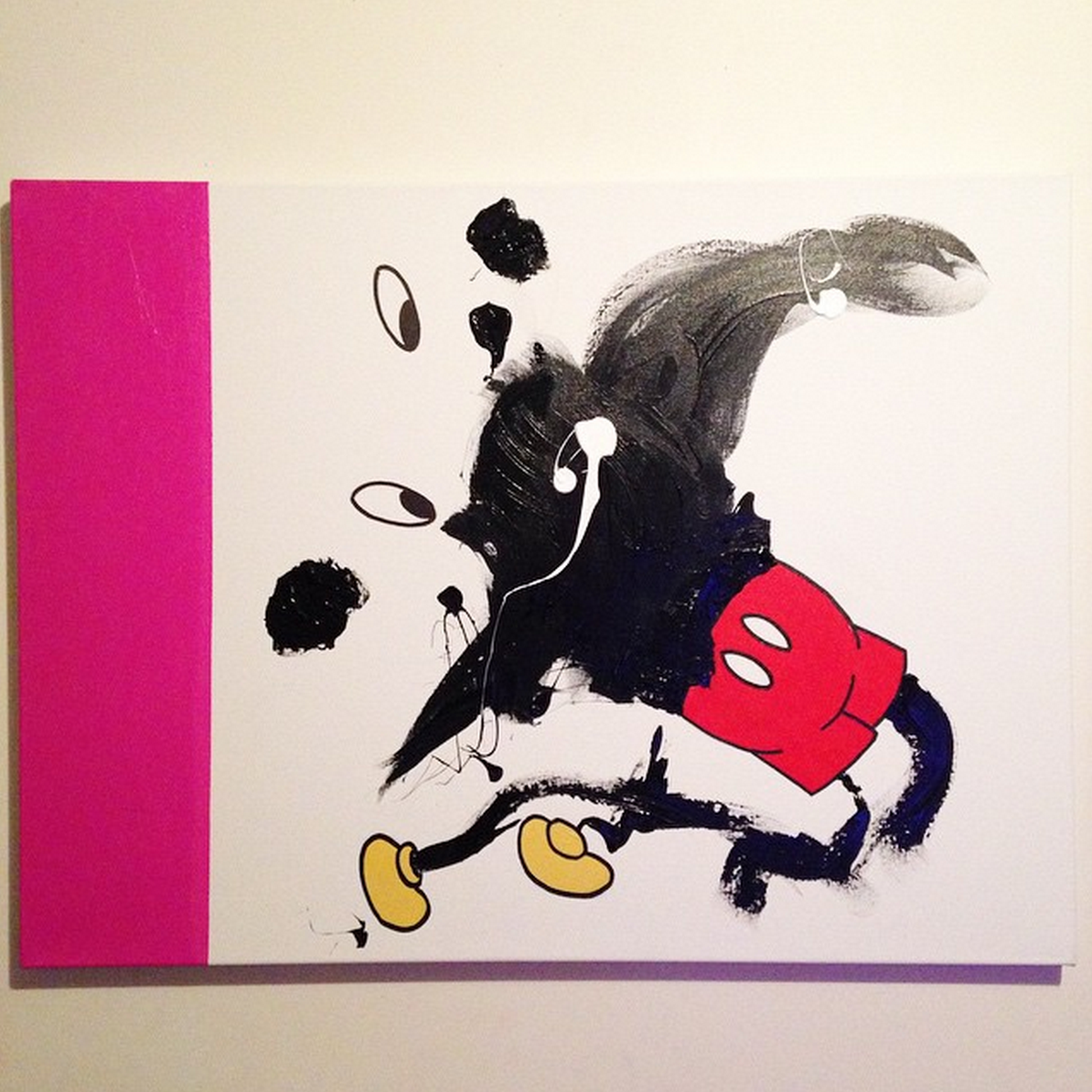
This new work kind of just happened. I was drawing Mickey to be the Mickey character as you know it. I was dealing with a girl and she made me upset. I took my frustrations out on the painting and it just happened. I thought, “Hmm, let me post this on social media and see what people think.” People were commenting saying they liked it more than my other style. I wasn’t sure if I should be offended or not. I was in a weird mood. They liked it, but did I really like it? That that goes to show what expression means to people. I started running with this new style, expressing more, adapting to it. I like it more.
ME: I love the goofy piece you did.
JUSTIN GILZENE: Yeah, I did that with the kids at Harlem Hospital.
ME: That’s awesome. Speaking of kids, they’ve come up a few times. It’s obvious you have a big heart. I know you’ve done quite a bit of charity work and you like giving back where you can. You once said, “I sketch. They paint.” Tell us more about this, what are you doing with the kids and why giving back is so important to you?
JUSTIN GILZENE: I am the Art Coordinator for Harlem Children’s Zone. Part of my job is to do murals on eight or nine walls. It’s fun interacting with them, getting their ideas on what to put on the walls and I get to make it a reality. Their minds are plagued so I want to do as much as possible to affect the negativity in their minds through art.
I’m also working with Harlem Hospital. The Chief of Staff recently commissioned me to update the Pediatrics Center.
ME: Wow, that’s great. Has faith played a role in any of this? How has your faith helped you grow as a painter?
JUSTIN GILZENE: It’s helped me in life in general, not just as a painter. Since I’ve grown up, I’ve seen some friends not doing so well, one friend in prison, some are just continuing that cycle. I look at myself, “What am I doing?” Life is a choice. God blesses us with choice.
“I imagine how God must feel if He’s dealing with that for everyone in the whole world.”
ME: What keeps your faith up?
JUSTIN GILZENE: You never know how someone feels until you feel what they have felt. I think about how disappointed I am when I am trying to help someone and they aren’t listening to me, continuing in their own way after I show them. That breaks my heart. This made me open up my heart and soul. I imagine how God must feel if He’s dealing with that for everyone in the whole world. My faith inspires me to do good, to do better. God has blessed me with this passion and love and I want to do as much as I can with it. He blesses me with new ideas all the time for my paintings.
I always pray when I wake up, before I go to sleep, when I eat, when I’m walking home, I pray for creativity.
ME: Prayer is key. Do you have any life defining moments that have shaped you that you’d like to share?
JUSTIN GILZENE: I remember this day in high school, I was angry, not angry angry, it takes a lot for me to get upset. The day started off rough, then, at school, everyone was bothering me. I was talking to one girl and she got upset, her friends were goofing around with me, taking my shoes, holding me. They were playing, but I wasn’t in the mood. So I punched what was near me, a glass window. My whole wrist was cut open, I saw my bones, I cut a tendon. The doctor said I was .5 cm away from cutting my main artery. See what happens when you don’t make the right choices or don’t take the time to think and evaluate the choices? If I would’ve punched a little harder, I could’ve bled to death.
ME: Wow. That’s deep. What about with art, any defining moments you can think of you?
JUSTIN GILZENE: Honestly, it’s all the time. People saying you’re my role model, I believe in you. Even kids saying they look up to me. Whoa, me? I’m just a human being. Comments on Instagram, people saying I commend you, keep up the hard work… I’m grateful for all of that. That fuels me to become who I need to be.
This slideshow requires JavaScript.
ME: What does creating with purpose mean to you?
JUSTIN GILZENE: Based on my passion and love, I want to share it to help inspire, to motivate and to help everyone see our own flaws and the flaws in the world. I’m not scared to talk about the injustice in the world, politics, race, white supremacy. I’m not afraid to talk about love and hate against our black people, black on black crime. I want to talk about these things through my art. It’s not about the money. Someone asked me why I do my canvases so big. It’s a reflection of how I was raised. I never had my own space. I always had to share. The big canvas is creative freedom, freedom to express; I’m in my own world. I don’t really like doing things small. My purpose is to get the message out there. I’m putting it in the atmosphere, the universe, into everyone’s world. I want that impact on everyone in the world, to build a legacy based on my art and the love I put into my art, into people. That’s why I’m living.
Thanks again Justin, can’t wait to see all the exciting things you’re working on!
Keep up with Justin’s work, @club_bum on Instagram and keep an eye out for his work in the Harlem Hospital gallery and Pediatric Center later this year. If you’re interested in commissioning or purchasing work, you can reach him at justingilzene@aol.com.






 Moti Laine